
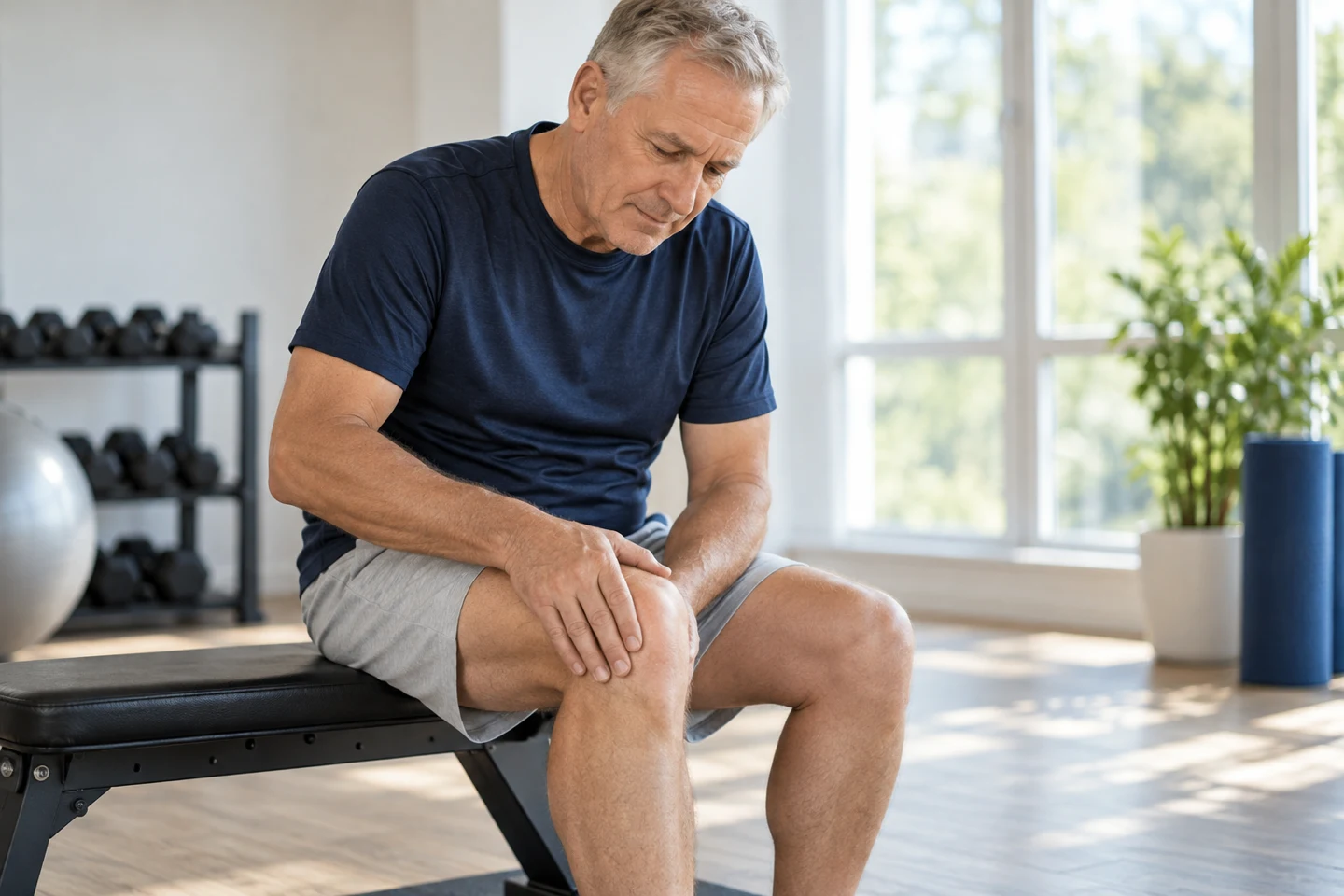
A knee that feels comfortable on level ground may complain when you climb the stairs at home. You might notice an ache around the kneecap, stiffness after sitting, or a sore spot below the knee. Those details are worth noting, but they do not identify the cause on their own.
For Hopkinton residents heading into a busy November, the practical question is often simple: What should I change, and when should I get help?
Why stairs can bring out knee pain
Stairs repeatedly bend the knee while it supports your weight. Pain during this movement is a clue, not a diagnosis. [1]
Three common possibilities
Patellofemoral pain. This often causes an ache at the front of the knee or around the kneecap. Stairs, squatting, and sitting with bent knees can provoke symptoms. A recent increase in activity may contribute, and you do not have to be a runner to experience it. [1]
Osteoarthritis. Knee osteoarthritis can cause pain with activity, swelling, and stiffness after resting. Symptoms often develop gradually. Although it is more common with age, younger adults can develop it too, including after a joint injury. It affects more than cartilage, so describing every sore knee as simple “wear and tear” misses the fuller picture. [2]
Patellar tendon pain. The tendon below the kneecap helps connect the kneecap to the shin. Tendinopathy can cause localized soreness with stairs, running, or jumping, sometimes after a change in exercise. Symptoms may ease during activity and return afterward. Location alone cannot reliably distinguish it from other knee problems. [3]
These are examples, not a complete checklist. A new injury or a swollen, unstable knee needs a different assessment from a mild, gradually developing ache.
Reasonable first steps for mild symptoms
If symptoms are mild and there are no warning signs below, temporarily reduce activities that clearly aggravate them. That may mean pausing extra stair workouts, jumping, or hill sessions. Consider a less irritating activity, such as easy cycling or swimming, if comfortable. [3]
For short-term relief, a cold pack wrapped in a towel can be applied for up to 20 minutes. Keep ice off bare skin. [4]
Keep a brief record of where the pain occurs, when it started, and whether a recent workout or daily routine changed. Bringing those details to an appointment is more useful than repeatedly testing the painful movement.
Exercise should fit the problem
Exercise may be part of treatment, but an online routine is not an individualized plan. For patellofemoral pain, rehabilitation may include hip and thigh strengthening. Tendon problems may benefit from gradually increased strengthening. Appropriate exercises and progression depend on the assessment. Avoid assuming that deeper squats or more repetitions are the answer to unexplained pain. [1], [3]
When to arrange an evaluation
Schedule an appointment if discomfort keeps returning, limits normal activities, or has not improved after a few weeks. An assessment can review your symptoms and examine movement, strength, and stability to help determine the next step. Treatment depends on the cause; a scan or a particular therapy is not the starting point for every knee complaint. [4], [1]
Warning signs: seek urgent medical care
Get prompt medical help rather than waiting for a routine appointment if:
- Pain is severe, or you cannot move the knee or bear weight.
- The knee becomes markedly swollen or changes shape.
- It locks, gives way, or clicks painfully.
- It is red or hot and you have a fever, chills, or feel unwell.
A hot, red knee with fever can indicate infection. These symptoms need medical assessment. [4]
Quick questions
Does stair pain mean arthritis?
No. Several conditions can cause it, and symptoms overlap.
Is painless clicking a warning sign?
Painless clicking is usually normal. Clicking with pain, locking, or giving way deserves medical attention. [4]
Should I push through it?
Reduce the activity that aggravates symptoms and seek guidance if pain persists. [3]
Takeaway: Notice the pattern, adjust aggravating activity, and get persistent or concerning symptoms assessed. For nonurgent questions, contact Cedar Chiropractic & Sports in Hopkinton to discuss an appropriate next step. Learn more about our knee pain evaluations and sports chiropractic approach.
Sources
- AAOS: Patellofemoral Pain Syndrome
- NIAMS: Osteoarthritis
- Leeds Community Healthcare: Patella Tendinopathy
- NHS: Knee Pain
This article provides general education. It is not a diagnosis or a personalized treatment recommendation. Your history, examination, and goals guide care; suitability and results vary.